The Expiry Date on a Workaround: Running a Temporary Repair Register That Actually Closes
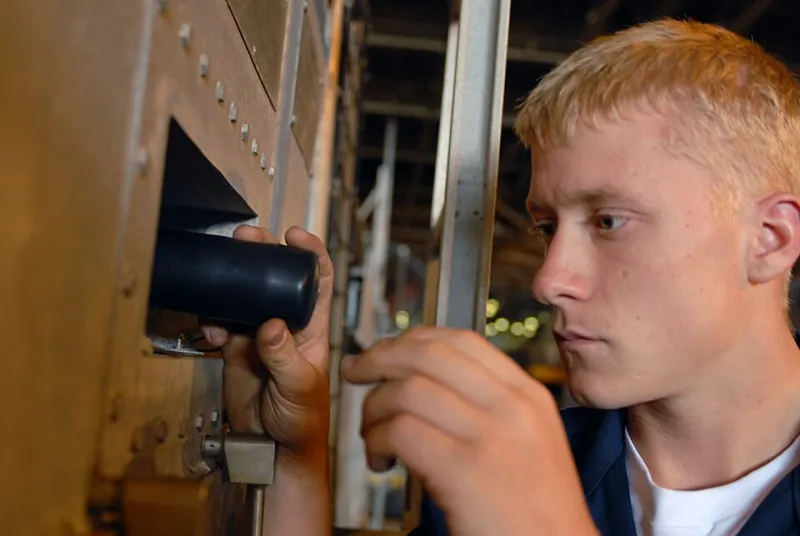
Photo: U.S. Navy photo by Mass Communication Specialist Seaman Andrew Brantley, Public domain, via Wikimedia Commons
A bypassed interlock on a packaging line, installed on a Friday afternoon so the shift could finish, is a reasonable decision. Six months later, with the fault forgotten and the bypass still in place, it is something else entirely. The plant has not become more reliable; it has become quietly less safe, and nobody owns the difference.
This pattern repeats across UK sites with remarkable consistency, and it rarely involves negligence. It involves good intentions, a busy week and the absence of a mechanism that forces a second look.
How a five-minute fix becomes permanent
Temporary repairs fail to close for predictable reasons. The person who made the decision moves shift, changes role or leaves. The fault stops causing trouble, so the pressure to return disappears. The permanent repair needs a shutdown window that is always three months away. A borrowed spare is fitted, works perfectly, and the original item is never reordered.
None of these is a maintenance failure in isolation. Collectively they create a drift in plant condition that no single work order captures, because the work was technically done.
A register changes the status of a workaround from an informal understanding to a recorded decision with a shelf life. It is a modest administrative tool, but it converts tacit knowledge into something a new supervisor can act on.
What belongs on the register
A temporary repair is any intervention that restores function without restoring design intent. That definition is deliberately broad, because the escapes are usually at the edges.
Typical entries include:
- Bypassed or inhibited interlocks, guards or safety devices
- Leaking seals, gaskets and flanges where a permanent repair needs isolation or draining
- Bearings running noisily but within tolerance
- Cable or pipe repairs using a method outside the specification
- Borrowed spares, where a component has been taken from another asset
- Temporary supports, clamps, patches and tie-wraps
- Control overrides, forced bits or disabled alarms
- Any reduction in capacity or throughput accepted to keep running
Safety-critical items, such as defeated interlocks, deserve a separate escalation path. Many sites already require management authorisation for an interlock override; the register should not replace that process, but it should ensure the override is time-bound and visible.
Rating risk without building a bureaucracy
A three-by-three matrix is usually sufficient. Score the consequence of failure as low, medium or high, and the likelihood of that failure occurring within the review period in the same way. The resulting position determines how quickly the item must be reviewed and who must sign it off.
| Rating | Review interval | Approval |
|---|---|---|
| Low | Up to 3 months | Supervisor |
| Medium | Up to 4 weeks | Maintenance engineer |
| High | 7 days or immediate | Engineering manager, with written justification |
Where a workaround affects a safety function, the risk position should be treated as high regardless of the arithmetic. The judgement is not about how likely a failure is to happen, but about whether the arrangement would withstand scrutiny after an incident.
Expiry dates, owners and escalation
Every entry needs a name and a date. The owner is accountable for driving the permanent repair, not merely for knowing about it. The expiry date should reflect the review interval above and be visible in the maintenance system, so that it appears in the weekly plan rather than depending on memory.
The escalation rule matters more than the rating. If the permanent repair has not been completed by the expiry date, three things should happen: the item is re-rated, the reason for the delay is recorded, and the decision to extend is taken by someone senior enough to accept the residual risk in writing. A second extension should require a higher level of approval again.
Extensions are not failures. Budget constraints and shutdown availability are real. The failure is an extension that nobody remembers granting.
Four entries that would appear on most UK sites
A bypassed light curtain on a manual load station is the classic example. The unit ran reliably for three days with the bypass in, which is precisely why it stayed. On the register, with a high rating and a seven-day review, it either gets fixed or becomes a documented management decision to run with a compensating control in place.
A dripping mechanical seal on a cooling water pump is a medium-rated entry. It stops dripping, the stain dries, the item drops off the radar. Two years later the pump bearing has failed because the seal was leaking onto it, or the baseplate has corroded. A review date at four weeks keeps the planned repair in view and the replacement seal on order.
A noisy bearing on an exhaust fan sits comfortably in the low-to-medium band. It usually has months of life left, which is exactly the argument for not deferring. Vibration trend and an expiry date together give a reasoned decision rather than a wait-and-see.
Borrowed spares are the quietest of all. A motor taken from a standby pump to keep a duty pump running leaves an asset functionally downgraded with no record anywhere. On the register, the borrowed item is flagged and the reorder is tracked, so that the standby is restored rather than simply forgotten.
Making it stick
Registers fail when they become a separate document maintained by one person. The entries should live in the CMMS as work orders with a mandatory expiry field, reviewed at the same weekly meeting where the plan is set. Ten minutes is enough if the list is short and honest.
It also helps to report the count and age of open temporary repairs alongside other maintenance metrics. A rising population, or a handful of entries older than six months, is a more useful signal about plant health than many of the standard indicators.
The purpose is not to discourage temporary repairs. They are a legitimate and often necessary part of running plant. The purpose is to make sure that a decision taken under pressure in a single shift remains a decision someone is still making deliberately, months later, with the risks in plain view.