The Briefing That Leaves a Mark: Toolbox Talks as Maintenance Records
A toolbox talk is sometimes treated as a ceremony that happens before the real work begins. The crew gathers, someone reads from a sheet, names are ticked, and everyone disperses. The paper that remains proves attendance, but it rarely proves much else. In maintenance work, that is a missed opportunity. A well-judged toolbox talk is not paperwork for its own sake. It is the shortest reliable record between a known risk and a closed action.
Why the sign-in sheet falls short
An attendance record answers one question: who was in the room. It does not show what was discussed, what site-specific hazard was identified, what was agreed, or whether the agreed action was completed. When an auditor, a incoming shift or a reliability engineer later asks why a particular control was in place, a list of signatures offers little support.
The gap matters most in maintenance because the work is rarely identical from one week to the next. A pump overhaul in a wet well, a valve change on a live steam line and a conveyor repair during production each carry different local risks. A generic briefing that could have been delivered anywhere leaves no trace of the risk that was actually present on the day. The record needs to be small, but it needs to be specific.
A compact record that does the work
A useful toolbox talk record does not require a lengthy form. It needs enough structure to answer four practical questions: what was the topic, what made it relevant here, who was briefed, and what happens next. In most UK maintenance settings, the following fields are sufficient:
- Date, location and asset or work order reference.
- The topic in one line, plus the trigger for the talk, such as a recent near miss, a change in method, a repeat fault or a seasonal hazard.
- Attendees and their roles, not simply signatures.
- The site-specific hazard discussed and the control agreed.
- Actions arising, with a named owner and a realistic due date.
- A follow-up point, such as review at the next shift handover or verification during the next planned maintenance visit.
The important discipline is to complete the record at the end of the talk, while the discussion is fresh. Waiting until the end of the shift invites reconstruction from memory, and reconstructed records tend to contain generalities. A five-minute close-out is usually enough: the facilitator reads back the hazard, the action and the owner, and the record is attached to the relevant work order or asset history.
The five-minute close-out in practice
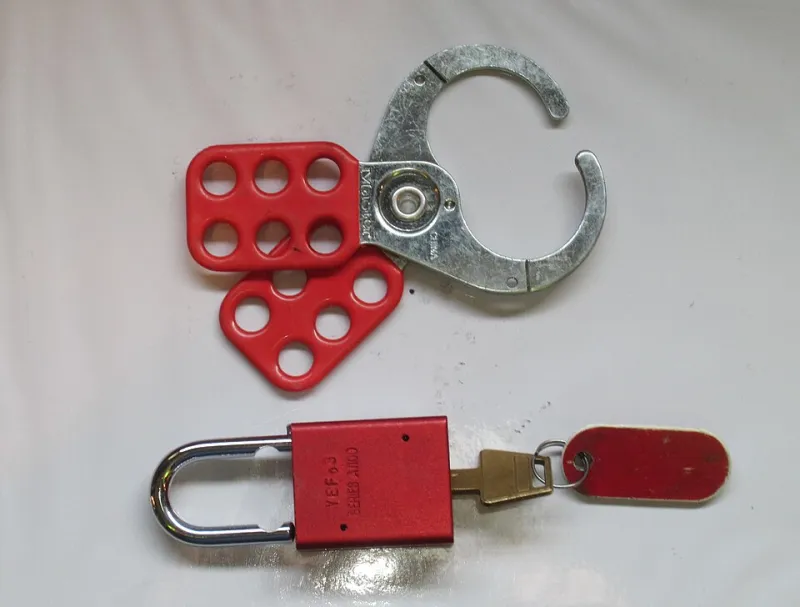
Consider a small repair on a process pump. The talk may cover isolation and lock-off, but the site-specific point is that the upstream valve has a worn handle and has previously passed. The control agreed is to fit a secondary isolation and to report the valve for replacement. The action is assigned to the maintenance supervisor, with a due date before the next production run. That single line is more valuable than a page of generic isolation guidance because it connects a local defect to a named response.
Or consider a conveyor repair during a live production window. The talk identifies that the guarding on the adjacent line is often removed for cleaning and not always replaced promptly. The action is not a new procedure; it is a short-term check at shift handover until the guard interlock is repaired. Recorded properly, that action can be verified, closed and referred to if the same issue recurs.
The routine should take no longer than the talk itself. The aim is not to create a parallel administrative system. It is to leave a short, legible trace that the team can use the next time the asset, the hazard or the question comes up.
What audits and handovers actually need
Auditors and assurance reviewers rarely expect a toolbox talk record to be a polished document. They look for evidence that risks were communicated and controls were not left hanging. A compact record that links the talk to a work order, names an action owner and shows a closure date gives them something to test. It also gives the maintenance team a defensible position if a later incident review asks what was known and what was done.
Handovers benefit in a different way. An incoming shift does not need to read every briefing from the previous month, but it does need to know which actions remain open. If the toolbox talk record sits with the asset or work order, the open action is visible at the point of use. That is more reliable than relying on someone remembering to mention it in a shift meeting.
Repeat faults are where the record earns its keep. A series of short entries showing the same hazard being discussed on the same asset is an early signal that the underlying defect has not been addressed. It may point to a design issue, a spares problem or a gap in the planned maintenance regime. Without those entries, the pattern remains anecdotal and is easily lost between shifts.
Keeping it light enough to last
A toolbox talk record only works if teams will complete it consistently. That means resisting the temptation to add fields for every conceivable purpose. A single-page template, stored with the work order or asset record, is usually enough. The topic should be written in plain language, not lifted from a procedure title. Actions should be few, specific and owned. Follow-up should be checked at the next natural pause, whether that is a handover, a weekly maintenance meeting or the next planned visit.
In UK operations, where maintenance teams are often stretched across multiple assets and sites, the record should also be easy to retrieve. A folder of scanned sheets that nobody can search is only slightly better than no record at all. Where a computerised maintenance management system is in use, a short text entry against the work order is often sufficient. The point is to keep the trace close to the work, not to create a separate archive.
Toolbox talks are not a substitute for a proper risk assessment, a permit or a safe system of work. They are a briefing at the point of work, and their value lies in their immediacy. A compact record preserves that immediacy. It shows what was known, what was said and what was done next. That is a modest paper trail, but it is often the one that answers the difficult question six months later.