The Hidden Wet Line: A Risk-Led Survey Routine for Insulated Pipework
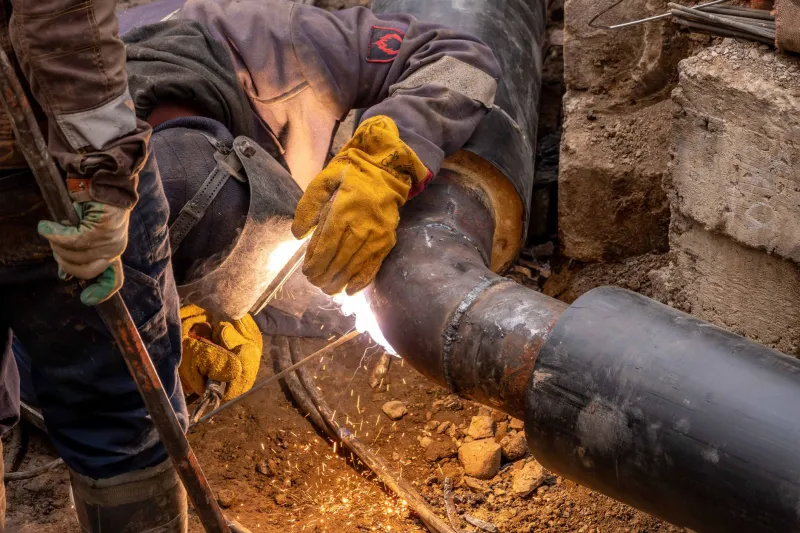
Corrosion under insulation is awkward precisely because it is well behaved. It does not discolour the cladding, it does not drip onto the walkway, and it does not appear on any weekly check sheet. It simply progresses beneath a barrier that was installed to keep heat in and, in practice, also keeps water in. By the time a pinhole becomes a leak, the inspection question has usually changed from "where should we look?" to "how much line do we replace?"
That does not mean every insulated metre should be stripped. A blanket cladding removal programme is expensive, generates large volumes of waste, disrupts operations, and — if reinstatement is rushed — can leave the asset in worse condition than before. The more defensible approach is to use evidence to decide where to open up, then to record what is found in a way that supports a planned repair programme.
Screen the Register Before Anyone Climbs a Ladder
The first pass is a desk exercise. Most sites already hold enough information to rank insulated lines by likelihood of attack, even if that information is scattered across P&IDs, insulation schedules, painting histories and maintenance records.
Useful screening criteria include:
- Service temperature. Carbon steel in cyclically operated service is generally regarded as the highest-risk band, with the risk falling away at sustained high temperatures and at genuinely cold service. Lines that swing between ambient and operating conditions deserve particular attention.
- Material and coating. Carbon steel and low-alloy steels are the usual concerns. The condition and age of the original paint system matters as much as the insulation type.
- Insulation specification. Certain insulation materials hold water and chloride more readily than others, and some historic specifications are known to be less forgiving than modern closed-cell alternatives.
- Environment. Coastal sites, areas downwind of cooling towers, washdown zones, steam vent discharge paths and anywhere with regular deluge or firewater testing all raise the score.
- History. Previous CUI findings, leaks, coating failures or cladding damage are the strongest predictor of future ones.
Ranking on these factors usually produces a manageable first tier — perhaps 10 to 20 per cent of the insulated population — that justifies close inspection. The rest can be held on a longer cycle with condition monitoring of the cladding itself.
The Places Water Actually Collects
Corrosion follows water, and water follows geometry. When planning inspection points, it is more productive to think in locations than in linear metres.
Priority points typically include:
- Low points and horizontal runs where the cladding has lost its fall
- Support shoes, saddle plates and trunnions, particularly where the cladding terminates around them
- Penetrations through walls, floors and roofs, where sealing is rarely maintained
- Valve bonnets, flange pairs and instrument connections, where cladding is often improvised
- Dead legs, spurs and blanked branches that never get hot enough to dry out
- Terminations and changes of direction, where sealant has aged
- Areas beneath leaking steam traps, sample points and level gauges
These are the positions where a small amount of inspection effort yields a disproportionate amount of information. A survey that opens twenty well-chosen points will usually outperform one that opens two hundred random ones.
Non-Destructive Checks That Earn Their Keep
Not every question requires removal of cladding. A visual survey of the cladding and its seals should come first and is often underrated: dents, open laps, failed sealant, missing banding and corroded cladding fixings all indicate that water has had an entry route for some time. Scoring cladding condition is a legitimate screening output in its own right.
Beyond that, a combination of techniques is usually appropriate:
- Thermal imaging during warm-up can reveal saturated insulation, though interpretation is affected by emissivity, wind and the thermal mass of the line. It is a pointer, not a verdict.
- Moisture measurement through small inspection ports in the cladding gives a direct indication of lagging condition at that point.
- Guided wave and long-range ultrasonic testing from accessible pipe ends or exposed sections can screen lengths that would otherwise need scaffolding and stripping.
- Profile radiography remains useful on small-bore and difficult-to-access positions.
Each technique has blind spots. The purpose of combining them is to narrow the list of locations that justify physical opening, not to replace it.
Targeted Windows and Consistent Recording
Where inspection windows are opened, consistency matters more than quantity. Fix a standard record for each: line number, location reference, insulation type, cladding condition, evidence of moisture, coating condition, pit depth and percentage metal loss, photographic image with a scale, and a clear recommendation.
Photographs should be taken before cleaning and after, with the location marked. A photograph without a location reference is difficult to defend two years later when the repair is being scoped.
It is also worth sampling lagging where chloride attack is suspected, particularly on stainless steel lines where chloride stress corrosion cracking is a separate concern from straightforward wall loss.
A Register That Supports a Decision
The output of the survey should be a ranked repair register, not a pile of inspection reports. Each finding needs a risk score derived from consequence and likelihood, an estimated remaining life, a recommended action and a target date. Grouping actions by area and by access requirement allows the work to be bundled into planned shutdowns rather than executed as a series of one-off jobs, each requiring its own scaffold.
Where metal loss is modest and the line is dry, re-cladding with improved sealing and a shorter re-inspection interval is a legitimate outcome. Where loss is significant, replacement of a spool or a change of insulation system — for example to a closed-cell product — may be more economical over the remaining life of the plant.
Reinstatement Decides the Next Survey
Finally, the quality of reinstatement determines whether the exercise has to be repeated. Cladding should be refitted with correct laps, new sealant, proper banding and, where relevant, a drainable detail. Vapour-tight does not mean permanently sealed everywhere: it means water has a route out and no route in.
A survey is only as useful as the repairs it triggers and the standard of the work that closes them out. Treating it as a scheduled, evidence-led activity — rather than a response to a leak — is what keeps insulated pipework from becoming a recurring emergency.