The Air You Pay For Twice: Five Compressed-Air Habits to Break
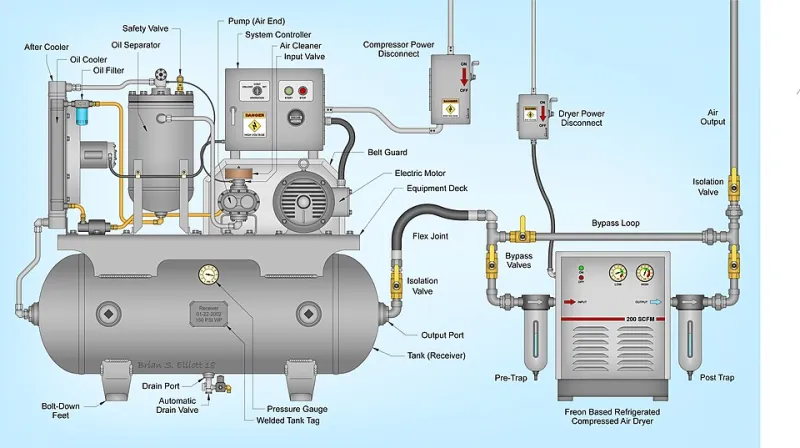
Photo: Brian S. Elliott, CC BY-SA 4.0, via Wikimedia Commons
A utility that hides in plain sight
Compressed air is convenient, flexible and deceptively ordinary. It powers tools, actuators, conveyors, packaging lines and cleaning stations across UK plants, and because it emerges from a familiar nozzle, it is easy to treat as free. It is not. Generating compressed air is energy-intensive, and every leak, pressure drop and oversized demand adds to the maintenance burden downstream. The plant pays twice: once for the electricity to make the air, and again for the components that fail because the system is working harder than it should.
The good news is that most compressed-air problems are habitual rather than inevitable. The following five habits are common, costly and correctable without a full system replacement.
1. Leaks treated as background noise
A persistent hiss is often dismissed as part of the soundscape. In reality, leaks are a continuous tax on the compressor and a slow wear mechanism for the whole system. They force the compressor to run longer, raise energy consumption and contribute to pressure fluctuations that shorten the life of valves, seals and actuators. In a busy plant, leaks can account for a significant share of compressed-air demand, and the cost is hidden in the electricity bill rather than a maintenance line item.
Practical checks include a walk-round at shift change when background noise is lower, soapy water testing on suspect joints, and an ultrasonic leak survey if the site is large enough to justify it. Quick wins include replacing worn quick-release couplings, tightening compression fittings, repairing damaged hose tails and introducing a tagged leak register. A leak is not fixed because it has been reported; it is fixed when it has been closed out and rechecked.
2. Dryers run on hope rather than dew point
Moisture is one of the quietest causes of compressed-air maintenance cost. Poor drying leads to corrosion in pipework, emulsified lubricants, sticky valves and premature failure of instruments and end-of-line equipment. In UK conditions, where ambient humidity is often high, a dryer that is overloaded, poorly maintained or operated outside its design envelope will struggle to deliver a consistent pressure dew point.
Maintenance teams should check that the dryer is matched to the actual demand and that its pre-filters and after-filters are not blocked. For refrigerated dryers, condensing drains and heat exchangers need attention. For desiccant dryers, purge settings and dew-point sensors deserve scrutiny. A quick win is to review the air-quality requirement by application rather than drying the whole system to the highest standard. Not every task needs instrument-grade air, and over-drying is an energy cost with no maintenance benefit.
3. Filters changed by calendar, not condition
Filter elements are often replaced on a fixed interval because it is easy to schedule. That is not always wrong, but it can be wasteful. A filter changed too early costs money in parts and labour. A filter changed too late causes pressure drop, forces the compressor to work harder and may allow contaminants downstream. The maintenance bill appears in compressor loading, valve failures and product rejects rather than in the filter budget.
The practical check is differential pressure where gauges are fitted, supported by a visual inspection of the element and housing. If the site has no differential pressure indication, that is a worthwhile small capital improvement. Quick wins include labelling filter housings with the correct element reference, keeping a small critical stock of the right elements and checking that bypass arrangements are not left open after maintenance.
4. Oversized demand and inappropriate use
Compressed air is sometimes used because it is available, not because it is the best medium. Open blowing for cleaning, venturi vacuum generation, sparging and cooling can all be legitimate, but they are often applied without checking whether a fan, brush, vacuum pump or mechanical solution would do the job at lower cost. Oversized demand also shows up as unnecessary pressure at the point of use. Every extra bar at the tool can add to the compressor load and increase leakage rates.
The check is to walk the line and ask what each air consumer is doing and at what pressure it actually needs to operate. Quick wins include pressure regulators at the point of use, engineered nozzles instead of open pipes, solenoid valves that shut off air when equipment is idle, and a review of equipment that runs on air simply because it always has. These changes rarely require a new compressor; they require a clearer picture of demand.
5. No measurement, so no one owns the bill
Compressed air is often unmetered at the department level. The compressor runs, the utility bill arrives, and no one can say which line or shift is driving the demand. Without measurement, leaks are invisible, poor practices persist and maintenance costs are attributed to bad luck rather than system condition. The result is a cycle of reactive repairs with no feedback loop.
A practical starting point is to log compressor run hours, loading and pressure, then compare them with production activity. Portable flow meters can be used to baseline specific areas without a permanent installation. Quick wins include a weekly pressure and run-hour check, a simple leak and repair log, and a named owner for compressed-air performance. Once the numbers are visible, the conversation changes from anecdote to evidence.
The maintenance dividend
Compressed-air efficiency is often framed as an energy project. It is also a maintenance project. Leaks, moisture, clogged filters and unnecessary demand all accelerate wear on valves, actuators, tools and instruments. By breaking the five habits above, UK plant teams can reduce maintenance interventions while protecting the compressed-air performance the process depends on. The first step is not a new system. It is a closer look at the one already installed.
Apex Engineering Services supports UK operations with practical plant maintenance reviews, including compressed-air system checks and reliability improvement programmes.